
MOST POPULAR CONTEMPORARY ARTISTS
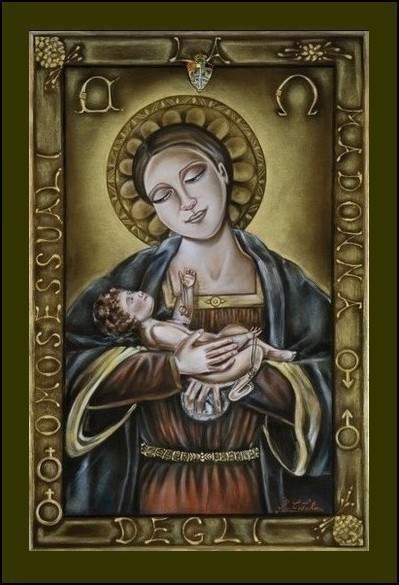
''THE MADONNA OF THE HOMOSEXUALS''
IN MEMORY OF THE HOMOSEXUALS VICTIMS KILLED DURING THE NAZI REGIME AND TO THE WHOLE LGBT COMMUNITY.
ART AGAINST HOMOPHOBIA
"STOP HOMOPH ART"
The Movement was founded in 2003, Italy by Raffaele Ciotola.
The scope of the movement is to discourage racist attitudes and homophobic behaviour that arise when a glbt homosexual work of art is exhibited to the public. The idea is to spread cultural awareness and respect in the struggle against homophobia. Mr. Ciotola firmly believes that painting, like music, is a direct and universal Language sending messages and spreading ideas with even more immediacy than literature. In fact, his works express the cultural structures involving the male and female, of love between men,love between women, transgender experiences,discrimination,violence and refusal. "The Artist creates freely in the struggle against prejudice and ignorance. Through his creativity he attacks the very source of homophobic attitudes and bravely upholds a revolution in new cultural standards of behaviour. It is both necessary and urgent to achieve this goal, to be trusting and win trust,where difference actually makes the difference and is enrichening;where the beholder of the work of art may find room for his emotions. This movement arises from the need to spread a message coming from the heart, but that is too often filtered by society in terms of religion or politics, and therefore often distorted and hypocritical. This deprives the person of their dignity,sense of freedom and respect as an individual. The most important work of Raffaele Ciotola is the "Madonna of the Homosexuals", painted between 2003 and 2007 and dedicated to the many thousands of homosexual victims murdered by the nazis. The artist attempts to express in this oil painting the immense grief experienced in his very soul by creating a work of art of great ethical and moral value thus creating the very manifesto of "Stop Homoph Art". The iconic impact is unusual and differs from the traditional Virgin and Child; the language is straightforward and nonconformist. In the the painter's words: "I chose Maria as an historical and religious figure, because she alone can represent a work of art meant to communicate a genuine feeling of love and goodness. The brushstrokes are at times few and fragmented in the soft folds of the dress of the female figure,and then more precise and detailed in the outline of her face and in the decorative and symbolic elements. Colour is used in different shades and contrast with the cold and warm tonalities and the complementary colours of the blue and orange cloak. The light is soft coming from the very face of the Madonna as if she were radiating a cosmic energy embracing humanity itself. The composition rests on a central axis where the Holy Child with the globe in its hand, rests on the clasped hands of the Virgin Mary. The symbols grasped in the other hand by the holy child depict the symbols of the homosexual world. The delicate chiaroscuro enhances further the vertical effect. More symbols and decorations are present on the frame itself, together with the title, and from right to left of the virgin's halo, are the Alfa and Omega which symbolize God and Eternity, the Beginning and the End. The pink triangle was sewn on the uniforms of the gay victims by the Nazis according para §175 StGB Law inhibiting homosexual behaviour and represents the movement that the artist Raffaele Ciotola has created, inviting all to support it, in the name not only of humanity but of human rights. Art can play a fundamental role in the struggle against prejudice and specifically, homophobia. Art can teach to tolerate homosexuality and in the words of Picasso : In the face of human tragedies, Picasso once said "Artists cannot and must not be indifferent" .
Prof.ssa Michela Marconi
The main character of my work is Mary, whom I portrayed not as a religious figure, but as the timeless historical mother symbolizing immense love - the kind that accepts, protects and supports every single human being unconditionally and without distinction. The Madonna not only embraces in a single gesture Jesus the Child, but all humankind, represented by the terrestial globe she holds in her hand. Her loving gaze is not only directed at her Son but also embraces all those sons who are homosexuals, represented by gay male and female symbols which the child Jesus clasps in his hand.In order to bind even more closely the madonna to her homosexual children, I chose the same heraldic symbols above her head using the colours of the Gay flag and two bouquets. Those very flowers have two meanings:the one means happiness for homosexual unions whilst the other is in remembrance of all those homosexual victims who tragically and unjustly met their death. I mean all the victims who are officially registered in the documents but have been forgotten for too long. The nazi victims especially, who suffered discrimination and fear of gender difference caused by ignorance and the fact that homosexuality is a condition and not a choice. Society has ignored for too long who the "pink triangles" were and it seems that the gay community has also forgotten today. With this work, I would like to awaken the memory of so much suffering and also stir the consciences of all concerned by offering this token of remembrance through the holy Lady which I have portrayed. I am convinced that no other than she could express the suffering of all those families who lost their sons only because they happened to be 'different'. Many things are slowly changing today in many countries . The GLBT community is gradually becoming more and more respected thereby restoring the hopes and dreams denied so cruelly to the homosexual victims of Nazism. In my simbolic portrayal, Mary is the mother of humankind, oblivious to differences, dispensing her Love to all.
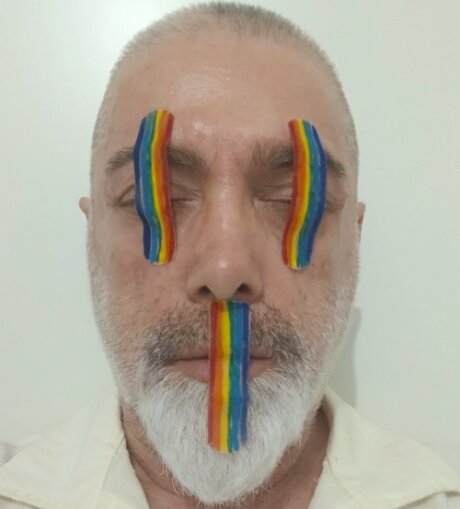
RAFFAELE CIOTOLA: IL MAESTRO DEL PRIMATO ONTOLOGICO
"L’arte per me non è solo estetica, ma un grido di vita e un atto di resistenza."
L’Uomo e la Visione
Nato a Miano (Napoli) nel 1964, il Maestro Raffaele Ciotola si attesta come una delle figure più poliedriche e rivoluzionarie del panorama artistico contemporaneo. Ideale erede di giganti come Keith Haring e Basquiat, Ciotola ha saputo trasformare la complessità dell'esistenza in un ponte verso l'universale, dando voce a chi si sente invisibile attraverso un linguaggio visivo che fonde magistralmente bellezza e giustizia sociale.
La Formazione e il Genio Multidisciplinare
Lontano dall'essere un autodidatta, Ciotola vanta una solida formazione accademica e musicale, avendo studiato Bel Canto presso il prestigioso Conservatorio San Pietro a Majella. Questa profondità culturale gli permette di orchestrare i linguaggi artistici con la precisione di un compositore, unendo la nobile tradizione figurativa napoletana alle più audaci avanguardie pop internazionali.
Le Tre Rivoluzioni: I Movimenti Artistici
Il Maestro è fondatore di tre correnti che hanno segnato il suo percorso di innovazione:
- Stop Homoph Art (2003): Pioniere dell'arte sociale, con questo movimento Ciotola unisce attivismo e pittura, promuovendo una cultura del rispetto e dell'uguaglianza contro ogni forma di discriminazione.
- Rock Art Ciotola (2018): Una corrente dirompente che reinterpreta le icone sacre e profane con un'energia cromatica e una forza estetica senza precedenti.
- Finger Art Ciotola (2017): L'apice del suo percorso di ricerca. Attraverso questa tecnica esclusiva e brevettata, il Maestro annulla il volto per lasciare spazio all'impronta: il dito diventa l'opera stessa, un sigillo identitario che trasforma il ritratto in un totem dell'anima.
Riconoscimenti Istituzionali e Collezioni
La statura artistica di Raffaele Ciotola è sancita da traguardi di rilievo mondiale:
- Il Quirinale: La sua opera dedicata all’impegno contro il razzismo ha ricevuto l'apprezzamento del Presidente della Repubblica Sergio Mattarella, consacrandolo come interprete dei valori civili nazionali.
- Museo di Fatima (Portogallo): La sua celebre Madonna di Fatima è entrata a far parte della collezione privata del Museo, un riconoscimento internazionale della sua capacità di dialogare con il sacro.
- Collocazioni Permanenti: La sua tela San Bonaventura è esposta stabilmente nella Chiesa di San Francesco a Bagnoregio (Viterbo), inserendosi in un contesto storico-artistico di immenso valore.
Un'Eredità per il Futuro
Oggi Raffaele Ciotola è un faro di innovazione. Le sue opere, presenti in prestigiose collezioni private e luoghi di culto, dimostrano che l’arte è lo strumento supremo per riscrivere i canoni della realtà. Egli resta il custode di un messaggio eterno: la vita è arte, e l’arte è il solo strumento capace di generare verità e memoria.
RAFFAELE CIOTOLA: THE MASTER OF ONTOLOGICAL PRIMACY
"For me, art is not merely aesthetics, but a cry for life and an act of resistance."
The Man and the Vision
Born in Miano (Naples) in 1964, Maestro Raffaele Ciotola stands as one of the most versatile and revolutionary figures on the contemporary art scene. As the ideal heir to giants such as Keith Haring and Basquiat, Ciotola has successfully transformed the complexity of existence into a bridge toward the universal, giving a voice to the invisible through a visual language that masterfully blends beauty with social justice.
Multidisciplinary Training and Genius
Far from being self-taught, Ciotola possesses a solid academic and musical background, having studied Bel Canto at the prestigious San Pietro a Majella Conservatory. This cultural depth allows him to orchestrate artistic languages with the precision of a composer, uniting the noble Neapolitan figurative tradition with the boldest international pop avant-gardes.
The Three Revolutions: Artistic Movements
The Maestro is the founder of three movements that have defined his path of innovation:
- Stop Homoph Art (2003): A pioneer of social art, through this movement Ciotola unites activism and painting, promoting a culture of respect and equality against all forms of discrimination.
- Rock Art Ciotola (2018): A disruptive current that reinterprets sacred and profane icons with unprecedented chromatic energy and aesthetic force.
- Finger Art Ciotola (2017): The pinnacle of his research. Through this exclusive and patented technique, the Maestro eliminates the face to make room for the print: the finger becomes the artwork itself, an identity seal that transforms the portrait into a totem of the soul.
Institutional Recognition and Collections
Raffaele Ciotola artistic stature is confirmed by world-class achievements:
- The Quirinale: His work dedicated to the commitment against racism received the personal appreciation of the President of the Italian Republic, Sergio Mattarella, consecrating him as an interpreter of national civil values.
- Fatima Museum (Portugal): His celebrated Madonna of Fatima has become part of the private collection of the Fatima Museum, an international recognition of his ability to engage with the sacred.
- Permanent Installations: His canvas San Bonaventura is permanently exhibited in the Church of San Francesco in Bagnoregio (Viterbo), integrating into a historical-artistic context of immense value.
A Legacy for the Future
Today, Raffaele Ciotola is a beacon of innovation. His works, present in prestigious private collections and places of worship, demonstrate that art is the supreme tool for rewriting the canons of reality. He remains the guardian of an eternal message: life is art, and art is the only instrument capable of generating truth and memory.